
Already eaten — what now?
For dogs and cats
If this was a small piece of plain store-bought button mushroom and your pet seems normal, observe. Keep the package or recipe. Call a veterinarian for a large amount, unknown ingredients, vomiting, diarrhoea, drooling or lethargy. For a wild or unidentified mushroom, seek advice immediately even if no signs are present. Do not induce vomiting yourself.
Variants and ingredients
Plain cooked store-bought button mushroomFor dogs and cats: Acceptable
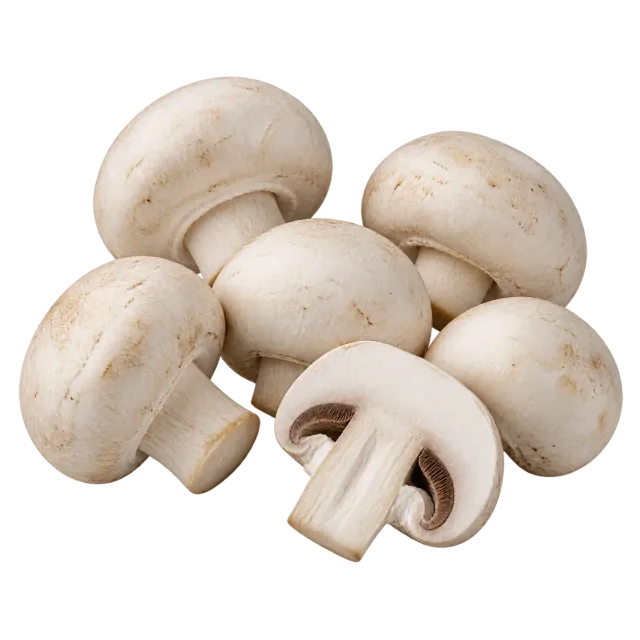
Fresh Agaricus bisporus cooked without fat, salt, seasoning or sauce.
For dogs and cats
Conditions and restrictions
Fully cook a fresh store-bought button mushroom without oil, salt, seasoning or sauce. Cool it, cut it into small pieces and offer only a little.
Benefits
A small piece can be an occasional treat, but it is not a dietary necessity.
Risks
- Even a suitable treat may upset digestion if too much is offered or a new food is introduced abruptly.
Already eaten — what now?
After a small piece with no signs, observation is enough. Call a veterinarian for repeated vomiting, diarrhoea, pain or lethargy.
Raw store-bought button mushroomFor dogs and cats: With restrictions
Fresh uncooked Agaricus bisporus from a food shop.
For dogs and cats
Conditions and restrictions
Only fresh store-bought Agaricus bisporus of known origin, washed and cut small. A plain cooked mushroom is the more cautious option.
Benefits
A small piece can be an occasional treat, but it is not a dietary necessity.
Risks
- Raw mushroom may be less well tolerated and cause vomiting, diarrhoea or abdominal discomfort.
Already eaten — what now?
After a small piece with no signs, observation is enough. Call a veterinarian for repeated vomiting, diarrhoea, pain or lethargy.
Dish with butter, cream, cheese or saltFor dogs and cats: With restrictions
A prepared mushroom dish with no onion or garlic but containing fat or salt.
For dogs and cats
Conditions and restrictions
If the dish definitely contains no onion, garlic or other hazardous ingredient, a small accidental bite usually calls for observation. Do not offer it deliberately.
Benefits
There is no benefit that justifies offering a fatty or salty mushroom dish.
Risks
- Fat, cream, cheese and salt add calories and may cause vomiting or diarrhoea.
- Even when a dish looks simple, a sauce or seasoning blend may contain onion or garlic.
Already eaten — what now?
Check the full ingredients and approximate amount. After a small bite with no signs, observe. Call a veterinarian for unknown ingredients, a large serving, vomiting, diarrhoea, pain or lethargy.
Dish containing onion or garlicFor dogs and cats: Dangerous · Urgent help needed
Fried, baked or marinated mushrooms, sauce or seasoning containing onion or garlic in any form.
For dogs and cats
Conditions and restrictions
Do not offer mushrooms containing onion, garlic, onion powder or garlic powder. Check sauces, seasoning blends and the full recipe.
Benefits
There is no benefit that justifies offering this dish.
Risks
- Onion and garlic can damage red blood cells in dogs and cats. Powders and dried flakes are concentrated forms.
- Signs of anaemia may take several days to appear, so do not wait for them.
Already eaten — what now?
Keep the package or recipe and call a veterinarian straight away. Give the species and weight, ingredients, amount and time. Do not induce vomiting. Weakness, pale gums, fast breathing, dark urine or collapse require immediate travel to a clinic.
Wild or unidentified mushroomFor dogs and cats: Dangerous · Especially dangerous
Any mushroom found outdoors, in a yard, forest, compost or plant pot, or a mushroom of uncertain identity.
For dogs and cats
Conditions and restrictions
Do not offer or allow access to mushrooms growing outdoors, in the yard, forest or a plant pot. Resemblance to a button mushroom does not make a mushroom safe.
Benefits
There is no benefit that justifies the risk.
Risks
- Different mushroom toxins may cause vomiting and diarrhoea, loss of coordination, tremors, seizures, liver failure or kidney failure.
- A dog or cat may look well at first: with some lethal toxins, the first signs are delayed by 6-24 hours or longer.
- Reliable identification is difficult even with a whole mushroom and becomes harder after chewing.
Already eaten — what now?
Move your pet away from the remaining mushrooms and call a veterinarian or the nearest open clinic immediately. Give the species and weight, time and approximate amount. If it does not delay travel, photograph the cap and underside and take a whole sample in a paper bag. Do not wait for signs or induce vomiting yourself.
Conditions and risks
For dogs and cats
Conditions and restrictions
Use only fresh store-bought Agaricus bisporus of known origin. It is best fully cooked without fat, salt, seasoning or sauce, cooled and cut into small pieces. Keep all treats below 10% of daily calories.
Benefits
Button mushrooms are not needed in the diet. A small piece can be an occasional treat if your pet likes the taste.
Risks
- A large serving or a raw mushroom may cause vomiting, diarrhoea or abdominal discomfort.
- Butter, cream, salt, sauces, onion and garlic change the risk of a prepared dish.
- A wild or unidentified mushroom may contain toxins that damage the liver, kidneys or nervous system, and signs can be delayed.
Short answer: a dog or cat can occasionally have a small piece of fresh store-bought button mushroom, fully cooked without oil, salt or seasoning. Do not offer a mushroom dish containing garlic or bulb onion.
Fried mushrooms often contain butter, cream or cheese. Do not deliberately offer that kind of dish, even when it contains no onion or garlic.
Sources
- Merck Veterinary Manual: Overview of Mushrooms Toxic to Animals
- Puschner and Wegenast (2018): Mushroom Poisoning Cases in Dogs and Cats
- VCA Animal Hospitals: Mushroom Toxicity
- American Kennel Club: Can Dogs Eat Mushrooms?
- Chewy, reviewed by Hannah Hart, DVM: Can Cats Eat Mushrooms?
- Merck Veterinary Manual: Garlic and Onion (Allium spp) Toxicosis in Animals
- WSAVA Nutrition Committee: Feeding Treats to Your Dog
- WSAVA Nutrition Committee: Feeding Treats to Your Cat
Comments
No comments yet.