
Already eaten — what now?
For dogs and cats
Call a vet straight away if the ingredients include raisins or cocoa/chocolate; xylitol ingestion in a dog needs immediate attention. After a small amount of plain curd cheese, if your pet is acting normally, remove the leftovers, leave water available and observe. Contact a vet for repeated vomiting, marked diarrhoea, pain, lethargy or refusal to eat. Also call the clinic if the amount was large for your pet’s size or the ingredients are unknown.
Variants and ingredients
Plain, without additionsFor dogs and cats: With restrictions
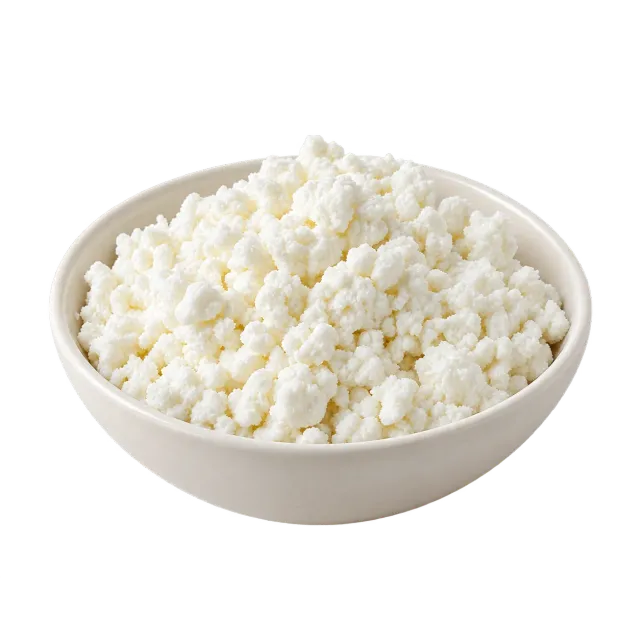
Fresh curd cheese made from pasteurized milk. Low fat does not mean lactose-free.
For dogs and cats
Conditions and restrictions
Use only fresh, unsweetened curd cheese made from pasteurized milk, with no added salt or fillings. A small occasional taste is acceptable for a healthy adult pet known to tolerate dairy. Avoid it after a previous reaction to dairy. Ask your vet before adding it to a therapeutic diet or feeding a pet with excess weight or pancreatitis. It cannot replace the main food or milk replacer for young animals.
Benefits
Tvorog contains protein, but there is no need to add it to a complete diet for extra nutrients.
Risks
- Residual lactose may cause gas, loose stools or vomiting.
- Fat and calorie content vary; large or frequent additions interfere with weight control and dietary balance.
Already eaten — what now?
After a small amount of plain curd cheese, if your pet is acting normally, remove the leftovers, leave water available and observe. Contact a vet for repeated vomiting, marked diarrhoea, pain, lethargy or refusal to eat. Also call the clinic if the amount was large for your pet’s size or the ingredients are unknown.
Lactose-free, without additionsFor dogs and cats: With restrictions
The risk from lactose is reduced; other restrictions remain.
For dogs and cats
Conditions and restrictions
Choose a product labelled lactose-free, made from pasteurized milk, without salt, sugar or other additions. Keep it small and occasional. It is still unsuitable after a reaction to milk protein; do not change a therapeutic diet without your vet.
Benefits
Tvorog contains protein, but there is no need to add it to a complete diet for extra nutrients.
Risks
- Reducing lactose does not remove milk proteins, fat or calories.
Already eaten — what now?
After a small amount of plain curd cheese, if your pet is acting normally, remove the leftovers, leave water available and observe. Contact a vet for repeated vomiting, marked diarrhoea, pain, lethargy or refusal to eat. Also call the clinic if the amount was large for your pet’s size or the ingredients are unknown.
Sweetened, without hazardous additionsFor dogs and cats: With restrictions
Sweet curd mixture, syrniki or casserole with ordinary sugar and a known recipe.
For dogs and cats
Conditions and restrictions
This variant covers desserts with ordinary sugar and no raisins, cocoa, chocolate, xylitol, alcohol or other hazardous additions. Do not offer them deliberately. Check the entire recipe of syrniki or casseroles, including the filling.
Benefits
There is no nutritional reason to offer this dessert to a pet.
Risks
- Sugar and added cream or butter increase calories; digestive upset remains possible.
Already eaten — what now?
Check the ingredients. If hazardous additions are definitely absent and only a little was eaten, observe. Call a vet after a large portion or for repeated vomiting, diarrhoea, pain, lethargy or refusal to eat. Identify an unknown sweetener straight away.
With raisinsFor dogs and cats: Dangerous · Urgent help needed
Raisins remain a concern in curd mixtures and baked dishes.
For dogs and cats
Conditions and restrictions
Do not offer curd cheese, syrniki or casseroles containing raisins. No universal safe portion of raisins has been established.
Benefits
There is no nutritional reason to offer this dessert to a pet.
Already eaten — what now?
Call a veterinarian straight away without waiting for symptoms. Give the species, weight, time, amount and full ingredient list; keep the package. Do not induce vomiting yourself. For seizures, collapse or breathing difficulty, leave for an open clinic immediately.
For dogs
Risks
- Raisins can cause acute kidney injury in dogs; early signs may be absent.
For cats
Risks
- Gastrointestinal signs have been reported in cats after grapes and raisins. Evidence of kidney injury is more limited than in dogs; no safe portion has been established.
With cocoa or chocolateFor dogs and cats: Dangerous · Urgent help needed
Includes coated curd bars when the coating contains cocoa.
For dogs and cats
Conditions and restrictions
Do not offer curd cheese or bars containing cocoa, dark chocolate or milk chocolate. Risk depends on the ingredients, amount eaten and body weight.
Benefits
There is no nutritional reason to offer this dessert to a pet.
Risks
- Theobromine and caffeine may cause vomiting, agitation, abnormal heart rhythm, tremors and seizures.
Already eaten — what now?
Call a veterinarian straight away without waiting for symptoms. Give the species, weight, time, amount and full ingredient list; keep the package. Do not induce vomiting yourself. For seizures, collapse or breathing difficulty, leave for an open clinic immediately.
With xylitolFor dogs: Dangerous · Especially dangerousFor cats: With restrictions
A separate variant with confirmed xylitol. Dog and cat ratings differ.
For dogs and cats
Benefits
There is no nutritional reason to offer this dessert to a pet.
For dogs
Conditions and restrictions
Do not offer it. Xylitol may be labelled E967 or birch sugar. “Sugar-free” alone does not confirm whether xylitol is present.
Risks
- Xylitol can cause a rapid, dangerous fall in blood glucose and liver injury in dogs. Signs may be delayed.
Already eaten — what now?
Call a veterinarian straight away without waiting for symptoms. Give the species, weight, time, amount and full ingredient list; keep the package. Do not induce vomiting yourself. For seizures, collapse or breathing difficulty, leave for an open clinic immediately.
For cats
Conditions and restrictions
Do not offer it deliberately. The yellow rating applies only to a curd dessert containing xylitol without other hazardous additions. Check the whole label.
Risks
- A small study of six cats found no toxic effect from xylitol. It does not establish safety for every amount or prepared dessert; the dairy base may cause digestive upset.
Already eaten — what now?
Remove the dessert and keep the package. Observe after a small amount if the ingredients are known and your cat is acting normally. Call a vet for an unknown amount or recipe, vomiting, diarrhoea, lethargy or refusal to eat.
Conditions and risks
For dogs and cats
Conditions and restrictions
Use only fresh, unsweetened curd cheese made from pasteurized milk, with no added salt or fillings. A small occasional taste is acceptable for a healthy adult pet known to tolerate dairy. Avoid it after a previous reaction to dairy. Ask your vet before adding it to a therapeutic diet or feeding a pet with excess weight or pancreatitis. It cannot replace the main food or milk replacer for young animals.
Benefits
Tvorog contains protein, but there is no need to add it to a complete diet for extra nutrients.
Risks
- Residual lactose may cause gas, loose stools or vomiting.
- Fat and calorie content vary; large or frequent additions interfere with weight control and dietary balance.
This card covers fresh curd cheese made from pasteurized milk. It can retain lactose, like other cow’s milk products. Fat-free does not mean lactose-free. Check the label of cottage cheese with added cream or salt.
Assess syrniki, curd casseroles and sweet curd mixtures by the full recipe. Tvorog does not remove the risks of raisins or chocolate. Check whether a coated curd bar contains cocoa, and check the sweetener whenever the label says “sugar-free”.
Sources
- ASPCA Poison Control: People foods to avoid feeding your pets
- Cornell Feline Health Center: Feeding your cat
- VCA: Nutrition and pancreatic disease in dogs
- FDA: Ways to reduce risk of HPAI in cats
- Merck Veterinary Manual: Grape, raisin and tamarind toxicosis in dogs
- Dijkman et al. (2022): Vitis fruit-induced clinical signs and acute kidney injury in dogs and cats
- MSD Veterinary Manual: Chocolate toxicosis in animals
- FDA: Paws off xylitol; it is dangerous for dogs
- Jerzsele et al. (2018): Effects of p.o. administered xylitol in cats
- ASPCA Poison Control: Is it ever safe to induce vomiting?
- UC Davis Veterinary Medicine: Allergies in pets
Comments
No comments yet.