
Already eaten — what now?
For dogs and cats
Remove the remainder and keep the packaging. After a tiny trace of plain mustard, monitor your pet. Call a veterinarian for a noticeable or unknown amount, powder exposure, repeated vomiting, blood, pain, weakness or breathing difficulty. Do not induce vomiting yourself.
Variants and ingredients
Tiny trace on otherwise safe foodFor dogs and cats: With restrictions
An accidental smear of plain mustard on food without onion, garlic, xylitol or other hazardous ingredients.
For dogs and cats
Conditions and restrictions
This describes an accidental trace, not a serving to feed. Check every ingredient in the food.
Benefits
The mustard provides no nutritional benefit.
Risks
- Even a small trace may cause brief drooling or stomach upset in a sensitive dog.
Already eaten — what now?
Offer access to water and monitor. Call a veterinarian if repeated vomiting, diarrhoea, pain, lethargy or unusual breathing develops.
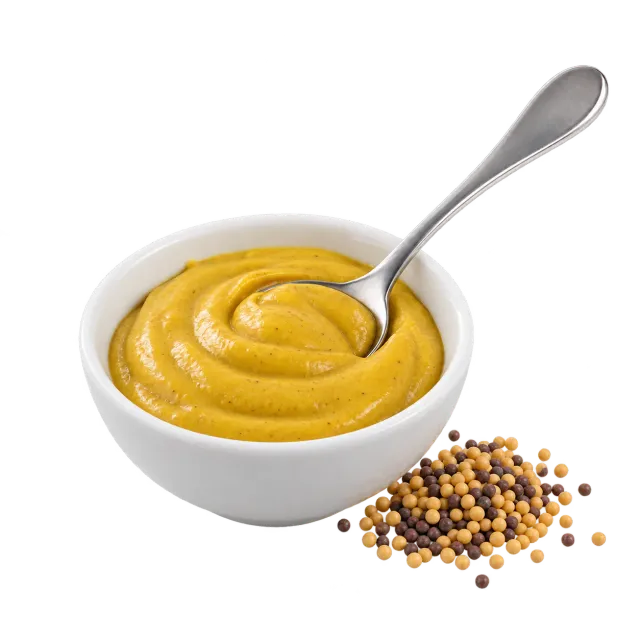
Prepared yellow or Dijon mustardFor dogs and cats: Dangerous
A prepared condiment made from mustard seed, water, vinegar, salt and spices.
For dogs and cats
Conditions and restrictions
Do not feed it deliberately. Keep the packaging because salt, spices and sweeteners change the risk.
Benefits
It is not needed in a pet’s diet.
Risks
- Mouth and gastrointestinal irritation, drooling, vomiting, diarrhoea and pain.
- Recipes vary and may contain onion, garlic, a high salt load or other hazardous ingredients.
Already eaten — what now?
Monitor after a tiny smear. For a noticeable or unknown amount, symptoms or a hazardous added ingredient, call a veterinarian and read out the ingredient list.
Mustard powder or crushed seedFor dogs and cats: Dangerous · Urgent help needed
A concentrated dry form that becomes airborne and mixes quickly with saliva.
For dogs and cats
Conditions and restrictions
Do not feed it or use it to induce vomiting. Keep it closed so the pet cannot inhale the powder.
Benefits
It provides no needed benefit to a pet.
Risks
- Concentrated irritant compounds can cause marked irritation of the mouth, oesophagus and stomach.
- Inhaling dry powder can injure the airways and lungs.
Already eaten — what now?
Remove the powder, move the pet away from airborne dust and call a veterinarian, especially if the amount is unknown. Leave urgently for coughing, difficult breathing, repeated vomiting or blood. Do not induce vomiting.
Sauce containing onion or garlicFor dogs and cats: Dangerous · Urgent help needed
A mustard sauce, marinade or dressing listing onion, garlic or their powder as an ingredient.
For dogs and cats
Conditions and restrictions
Do not feed it. Onion and garlic are hazardous when fresh, cooked or powdered.
Benefits
A pet does not need this sauce.
Already eaten — what now?
Call a veterinarian straight away with the pet’s weight, time, amount and full ingredient list. Do not wait for signs of anaemia or induce vomiting yourself.
For dogs
Risks
- The irritation from mustard is joined by the risk of oxidative red blood cell injury from onion or garlic.
- Signs of anaemia may be delayed, including weakness, pale gums, rapid breathing, dark urine or jaundice.
For cats
Risks
- The irritation from mustard is joined by the risk of oxidative red blood cell injury from onion or garlic.
- Cats are especially sensitive to this injury; weakness, pale gums, rapid breathing, dark urine or jaundice may appear later.
Conditions and risks
For dogs and cats
Conditions and restrictions
Do not add mustard to food or treats. Risk depends on the form, amount and full ingredient list.
Benefits
Mustard provides no necessary nutritional benefit to a pet.
Risks
- Isothiocyanates give mustard its pungency and can irritate the mouth, oesophagus, stomach and intestines.
- Drooling, vomiting, diarrhoea, poor appetite and abdominal pain may occur.
- Dry powder can enter the airways and damage the lungs.
This card covers culinary mustard made from seeds: prepared condiment, whole or crushed seeds and dry powder. Mustard greens, culinary or essential oil, and wild mustard plants need a separate assessment.
Read the full ingredient list on a prepared sauce. If it contains onion or garlic, use the bulb onion and garlic cards as well. Mixing these ingredients into a sauce does not remove their risk.
Sources
- MSD Veterinary Manual: Drugs Used to Control or Stimulate Vomiting in Monogastric Animals
- Today’s Veterinary Practice: Therapeutic Updates in Veterinary Toxicology
- Nagao et al. (2015): Intracolonic allyl isothiocyanate in conscious dogs
- California DPR (2022): Allyl Isothiocyanate Risk Characterization Document
- Eib et al. (2020): Mustard pungency and allyl isothiocyanate content
- MSD Veterinary Manual: Garlic and Onion (Allium spp) Toxicosis in Animals
Comments
No comments yet.