
Already eaten — what now?
For dogs and cats
Urgent help neededIf your pet ate a small amount of purchased, reliably identified, fully cooked plain chanterelle and remains well, remove the rest and observe. After a foraged, unidentified, raw or spoiled mushroom, call a veterinarian at once and keep a sample or photographs of the collection site. Do not wait for signs or induce vomiting unless a veterinarian instructs you to.
Variants and ingredients
Reliably identified, fully cooked and plainFor dogs and cats: With restrictions
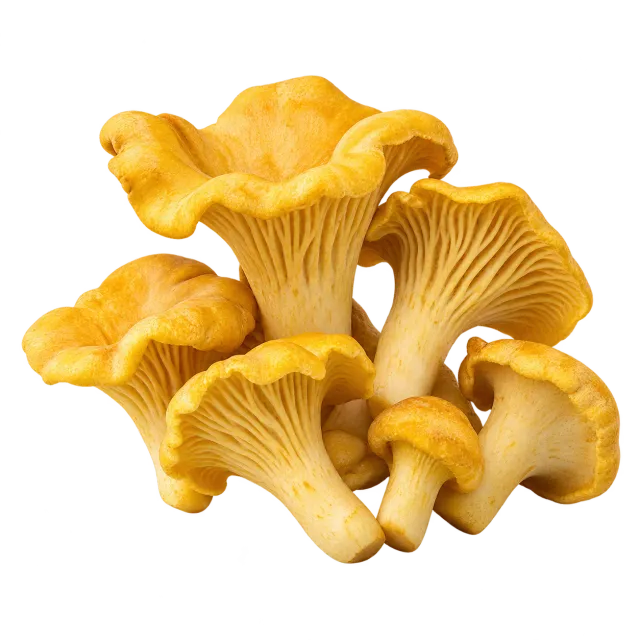
Fresh true chanterelles from a reliable source, cleaned, cooked through and served without other ingredients.
For dogs and cats
Conditions and restrictions
Use only reliably identified fresh mushrooms, fully cooked and cut into small pieces. Offer very little, without salt, oil, sauce, onion or garlic.
Benefits
Chanterelles are edible for people, but direct evidence of benefit for dogs or cats is lacking. Complete pet food does not need them.
Risks
- An unfamiliar food or a large amount may cause vomiting, diarrhoea, abdominal pain or reduced appetite.
- A large or tough piece can be difficult to swallow.
Already eaten — what now?
After a small amount with no signs, observe. Contact a veterinarian for repeated vomiting, diarrhoea, pain, lethargy, coughing or breathing difficulty.
Raw or undercookedFor dogs and cats: With restrictions · Urgent help needed
True chanterelles that have not been cooked through.
For dogs and cats
Conditions and restrictions
Do not feed raw or undercooked chanterelles. They should also be cleaned properly and cooked through for human meals.
Benefits
There is no benefit from feeding a raw or undercooked mushroom.
Risks
- Raw and undercooked edible mushrooms may cause nausea, vomiting, diarrhoea and abdominal pain.
- If the species was misidentified, the absence of immediate signs does not rule out severe poisoning.
Already eaten — what now?
If the mushroom was purchased and its identity is certain, call a veterinarian if any sign develops after a small amount. If it was foraged, bought from an unknown seller or its identity is uncertain, call at once and do not wait for signs.
Spoiled or mouldyFor dogs and cats: Dangerous · Urgent help needed
Mushrooms that are soft, slimy, darkened, mouldy or smell spoiled.
For dogs and cats
Conditions and restrictions
Discard mushrooms that are soft, slimy, darkened, mouldy or smell spoiled. Do not trim only the visible mould and feed the rest.
Benefits
A spoiled or mouldy mushroom offers no benefit.
Risks
- Spoiled mushrooms may cause marked vomiting, diarrhoea and dehydration.
- Mould toxins in spoiled food may cause poor coordination, tremors, seizures and high body temperature.
Already eaten — what now?
Remove the rest, keep the package or a sample, and call a veterinarian at once. Tremors, poor coordination, seizures, repeated vomiting, weakness or breathing difficulty require immediate travel to a clinic. Do not induce vomiting yourself.
Foraged or unidentified mushroomFor dogs and cats: Dangerous · Especially dangerous
A mushroom found outdoors, foraged at home or bought from an unknown seller whose identity has not been confirmed by an expert.
For dogs and cats
Conditions and restrictions
Do not let pets eat mushrooms outdoors. Do not judge safety by colour, smell, a photograph, or the fact that a person tasted the mushroom.
Benefits
No benefit from a foraged or unidentified mushroom justifies the risk of misidentification.
Risks
- Some mushroom toxins quickly cause vomiting, drooling, poor coordination, tremors or seizures.
- Other toxins injure the liver or kidneys, and the first signs may be delayed for many hours or days.
- Poisonous Omphalotus mushrooms are often mistaken for chanterelles and can cause severe gastrointestinal illness.
Already eaten — what now?
Call a veterinarian immediately, even if your pet looks well. Give the species, weight, time and possible amount. Keep a whole mushroom and photographs from above, below, the side and the growing site, without delaying travel. Do not induce vomiting or give home remedies unless instructed.
Dish with onion or garlicFor dogs and cats: Dangerous · Urgent help needed
Fried chanterelles, sauce, soup or another dish containing any onion, garlic or their powders.
For dogs and cats
Conditions and restrictions
Do not feed chanterelles with onion, garlic, onion powder or garlic powder. Cooking does not remove the Allium hazard.
Benefits
Onion and garlic do not add a useful benefit for the pet.
Risks
- Onion and garlic can oxidise red blood cells and cause haemolytic anaemia in dogs and cats.
- Weakness, pale gums, rapid breathing, dark urine and jaundice may not appear for several days.
- A rich sauce or a large amount of oil adds a further risk of digestive upset.
Already eaten — what now?
Keep the recipe or package and call a veterinarian at once, even if there are no signs. Give the pet’s weight, time, amount, and form of onion or garlic. Do not induce vomiting yourself. Weakness, pale gums, laboured breathing, dark urine, jaundice or collapse require immediate travel.
Conditions and risks
For dogs and cats
Conditions and restrictions
Establish the source and identity first. Consider only a small amount of reliably identified fresh mushroom, fully cooked and served without salt, oil, sauce, onion or garlic. Do not feed wild or unidentified mushrooms.
Benefits
True chanterelles have no proven benefit that makes them necessary in a dog’s or cat’s diet.
Risks
- Even an edible species can upset digestion when raw, undercooked or spoiled.
- Poisonous mushrooms can resemble chanterelles. Misidentification may lead to vomiting, neurological signs, liver or kidney injury, and death.
- Sauces and fried dishes often contain onion, garlic, excess fat or salt.
This card covers true chanterelles in the genera Cantharellus and Craterellus. Colour and shape alone do not confirm the species. Buying from an unknown seller or identifying a mushroom from a photograph at home is not the same as expert identification.
Check the whole recipe. Onion and garlic remain hazardous after cooking, so a mushroom sauce or stew cannot be assessed from the mushrooms alone.
Sources
- Puschner and Wegenast (2018): Mushroom Poisoning Cases in Dogs and Cats
- Merck Veterinary Manual: Overview of Mushrooms Toxic to Animals
- Pet Poison Helpline: Mushrooms
- University of Florida IFAS: The Common Chanterelles
- North American Mycological Association: Mushroom Poisoning Syndromes
- Merck Veterinary Manual: Overview of Mycotoxicoses in Animals
- Merck Veterinary Manual: Garlic and Onion (Allium spp) Toxicosis in Animals
- Cortinovis and Caloni (2016): Household Food Items Toxic to Dogs and Cats
Comments
No comments yet.