
Already eaten — what now?
For dogs and cats
After a few small pieces of plain celery with no symptoms, observation is enough. Call a veterinarian for repeated vomiting, diarrhoea, pain or lethargy. Choking or breathing difficulty needs immediate help.
Variants and ingredients
Fresh or cooked, in small piecesFor dogs and cats: Acceptable
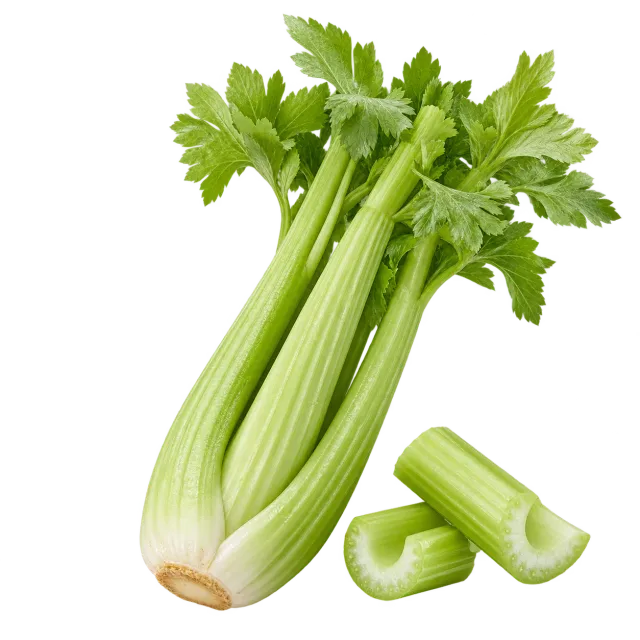
Washed plain celery cut across the fibres.
For dogs and cats
Risks
- A large or long fibrous piece can cause choking or lodge. Too much unfamiliar food may cause vomiting or diarrhoea.
Already eaten — what now?
After a few small pieces of plain celery with no symptoms, observation is enough. Call a veterinarian for repeated vomiting, diarrhoea, pain or lethargy. Choking or breathing difficulty needs immediate help.
For dogs
Conditions and restrictions
Wash the celery and cut it across the fibres into small pieces. Offer a little with no salt or seasoning. All treats together should stay below 10% of daily calories; ask your veterinarian first if your dog eats a prescribed diet.
Benefits
A low-calorie crunchy treat. Celery is not needed as a separate part of a balanced diet.
For cats
Conditions and restrictions
Offer only a tiny piece cut across the fibres, with no salt or seasoning. Do not use vegetables to replace complete cat food. Ask your veterinarian first if your cat eats a prescribed diet.
Benefits
Celery has no special benefit for a cat. A tiny piece can be an occasional treat if your cat likes it.
Whole stalk or long stripsFor dogs and cats: With restrictions
A large or long fibrous form that a pet may bite off or swallow.
For dogs and cats
Conditions and restrictions
Do not offer a whole stalk or long fibrous strips. Cut across the fibres into pieces the pet can chew and swallow comfortably.
Benefits
It offers no benefit over celery cut into small pieces.
Risks
- Long fibres and a large piece increase the risk of choking or lodging.
Already eaten — what now?
If the piece was swallowed and your pet is breathing comfortably, observe closely. Call a veterinarian for coughing, unproductive retching, heavy drooling, difficulty swallowing, repeated vomiting, pain or refusal to eat. Choking or breathing difficulty needs immediate care.
Dish with onion or garlicFor dogs and cats: Dangerous · Urgent help needed
Soup, salad, sauce or another mixture containing any Allium ingredient.
For dogs and cats
Conditions and restrictions
Do not offer soup, salad, sauce or a seasoned dish containing onion, garlic, chives, leek, shallot or their dried powders.
Benefits
There is no benefit for a pet.
Risks
- Allium plants can damage red blood cells and cause haemolytic anaemia. Signs may take several days to appear, and cats are more susceptible than dogs.
Already eaten — what now?
Do not wait for symptoms. Keep the package or recipe and call the clinic with your pet’s weight, the ingredients, time and possible amount. Weakness, pale or yellow gums, rapid breathing, dark urine or collapse need emergency care. Do not induce vomiting unless a veterinarian tells you to.
Conditions and risks
For dogs and cats
Risks
- A large or long fibrous piece can cause choking or lodge. Too much unfamiliar food may cause vomiting or diarrhoea.
For dogs
Conditions and restrictions
Wash the celery and cut it across the fibres into small pieces. Offer a little with no salt or seasoning. All treats together should stay below 10% of daily calories; ask your veterinarian first if your dog eats a prescribed diet.
Benefits
A low-calorie crunchy treat. Celery is not needed as a separate part of a balanced diet.
For cats
Conditions and restrictions
Offer only a tiny piece cut across the fibres, with no salt or seasoning. Do not use vegetables to replace complete cat food. Ask your veterinarian first if your cat eats a prescribed diet.
Benefits
Celery has no special benefit for a cat. A tiny piece can be an occasional treat if your cat likes it.
The green rating applies to washed fresh or cooked celery with no salt, oil, sauce or seasoning, cut to suit the pet. Celeriac, seeds, juice, extracts and essential oil are outside this assessment because they need separate evidence for their form and amount.
Check every ingredient in soup, salad or sauce. Onion and garlic remain dangerous after cooking, including dried powders.
Sources
- VCA Animal Hospitals: How To Choose Safe Holiday Foods for Pets
- VCA Animal Hospitals: Using Food and Treats for Training Dogs
- WSAVA Nutrition Committee: Feeding Treats to Your Dog
- WSAVA Nutrition Committee: Feeding Treats to Your Cat
- Merck Veterinary Manual: Garlic and Onion (Allium spp) Toxicosis in Animals
- Kew Science, Plants of the World Online: Apium graveolens L.
Comments
No comments yet.