
Already eaten — what now?
For dogs and cats
Remove the product and keep its package. Identify the form, ingredients, amount, time and your pet’s weight. After a small accidental taste of inactivated yeast with no hazardous additions, monitoring is usually enough. Call a veterinarian immediately if this was raw dough, the amount is unknown, or swelling, unproductive retching, drowsiness, unsteady walking or difficult breathing develops. Do not induce vomiting or give home remedies.
Variants and ingredients
Formulated pet food or pet supplement with a defined yeastFor dogs and cats: Acceptable
A product made for dogs or cats that identifies the yeast ingredient, target species and directions for use.
For dogs and cats
Conditions and restrictions
Use the product for the correct species and life stage, following its directions. Do not duplicate a supplement already present in a complete food; discuss it with the veterinarian during a therapeutic diet.
Benefits
In a formulated diet, a yeast ingredient may supply nutrients or perform its stated feed function. Any benefit depends on the specific product.
Risks
- A human supplement or a different strain does not inherit the assessment of a product formulated for pets.
Already eaten — what now?
No special action is needed after a normal serving of a suitable product. If your pet reached the package, ate far more than directed or swallowed packaging, keep the label and call a veterinarian.
Plain inactivated nutritional or brewer's yeastFor dogs and cats: With restrictions
A dry inactive product with no salt, garlic, onion, sweeteners or vitamin doses that were not formulated for the pet.
For dogs and cats
Conditions and restrictions
Do not feed it by the spoonful or use it as treatment. Check the full ingredient list. If you plan regular use, discuss the exact product and diet with a veterinarian.
Benefits
Yeast contains protein and other nutrients, but a complete food is already formulated. An improvised supplement has no proven universal benefit.
Risks
- A large or unfamiliar serving may cause vomiting, gas, soft stool or diarrhoea.
- Products made for people may contain additions that need separate assessment.
Already eaten — what now?
After a small accidental taste of a plain product, remove the rest and monitor your pet. Call a veterinarian after a large or unknown amount, repeated vomiting, marked swelling, diarrhoea, weakness or unusual behaviour.
Active dry or compressed baker's yeast without doughFor dogs and cats: With restrictions
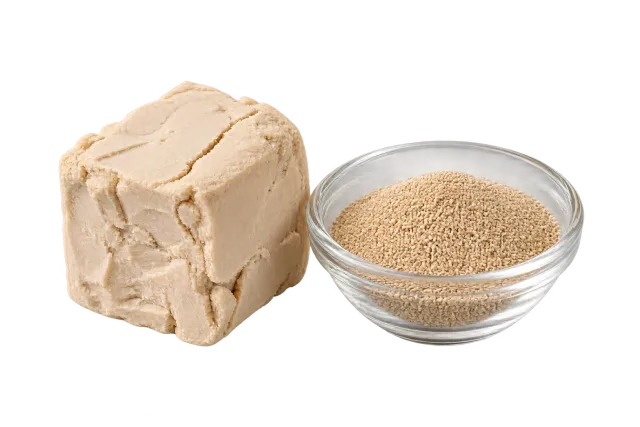
Active yeast powder, granules or a fresh cube before mixing with flour, sugar and liquid.
For dogs and cats
Conditions and restrictions
Do not offer active yeast and keep the package out of reach. This variant applies only to yeast before raw dough has been prepared.
Benefits
Baker's yeast is not needed as a treat or supplement for a dog or cat.
Risks
- Direct veterinary evidence for plain active yeast is limited; severe cases are better documented after raw dough ingestion.
- A noticeable amount may upset digestion, while available carbohydrate in the stomach can support fermentation.
Already eaten — what now?
After a few granules with no signs, remove the package and monitor your pet. Call a veterinarian if a packet or cube was eaten, the amount is unknown, the yeast was swallowed with dough, or swelling, vomiting, drowsiness or unsteady walking develops. Do not induce vomiting.
Raw yeast dough or active starterFor dogs and cats: Dangerous · Especially dangerous
An unbaked mixture with live yeast and available carbohydrate that can still rise and ferment.
For dogs and cats
Conditions and restrictions
Never offer a taste. Leave rising dough or starter only where pets cannot reach it.
Benefits
Raw dough offers no benefit and can cause severe poisoning.
Risks
- The dough continues to expand in the warm stomach and may cause painful distension, impaired blood flow to the stomach wall and breathing difficulty.
- Fermentation produces ethanol. Unsteady walking, disorientation, depression, low blood sugar, low body temperature, seizures, coma and death may follow.
Already eaten — what now?
Call an open veterinary clinic immediately and prepare to travel even if your pet still looks well. Report the ingredients, time, approximate amount and body weight. Leave at once for swelling, unproductive retching, drowsiness, unsteady walking, seizures or difficult breathing. Do not induce vomiting or try to stop fermentation with home remedies.
Conditions and risks
For dogs and cats
Conditions and restrictions
First identify whether the yeast is active, whether the product is made for animals and what else it contains. The main yellow rating covers an unspecified form; the variants below take priority.
Benefits
Defined yeast ingredients may be part of a formulated pet food. There is no reason to add kitchen yeast independently for a supposed benefit.
Risks
- Active and inactivated yeasts behave differently. The hazard from raw dough does not apply automatically to every yeast product.
- A mixture may contain salt, garlic, onion, sweeteners, vitamins or other ingredients that change the assessment.
- An unnecessary supplement may upset digestion and unbalance a calculated diet.
The word 'yeast' does not describe one product. This card separates active baker's yeast, inactivated nutritional and brewer's yeast, formulated feed products and raw dough. A yeast infection of the skin or ears is outside its scope.
If your pet ate a finished baked product, check the bread card. Fully baked bread and raw dough have different assessments.
Sources
- MSD Veterinary Manual: Bread Dough Toxicosis in Animals
- ASPCA Animal Poison Control: People Foods to Avoid Feeding Your Pets
- Suter (1992): Presumed ethanol intoxication in sheep dogs fed uncooked pizza dough
- EFSA FEEDAP (2024): Saccharomyces cerevisiae DSM 34246 for cats and dogs
- Commission Implementing Regulation (EU) 2025/154
- Davenport et al. (2023): dried yeast in dog and cat foods
- Maturana et al. (2023): Saccharomyces and derivatives in dogs and cats
Comments
No comments yet.