
Already eaten — what now?
For dogs
After a small piece of fresh, shelled, plain kernel, monitoring is usually enough. Confirm the amount and check for mould, shell, chocolate, onion, garlic or sweetener. Call a veterinarian for vomiting, diarrhoea, abdominal pain, lethargy or itching. Coughing, choking, facial swelling or breathing difficulty need urgent care. Do not induce vomiting yourself.
For cats
Monitor after a crumb of fresh, shelled, plain kernel. Confirm the amount and check for mould, shell, chocolate, onion, garlic or sweetener. Call a veterinarian for vomiting, diarrhoea, pain, lethargy or refusal to eat. Coughing, choking, facial swelling or breathing difficulty need urgent care. Do not induce vomiting yourself.
Variants and ingredients
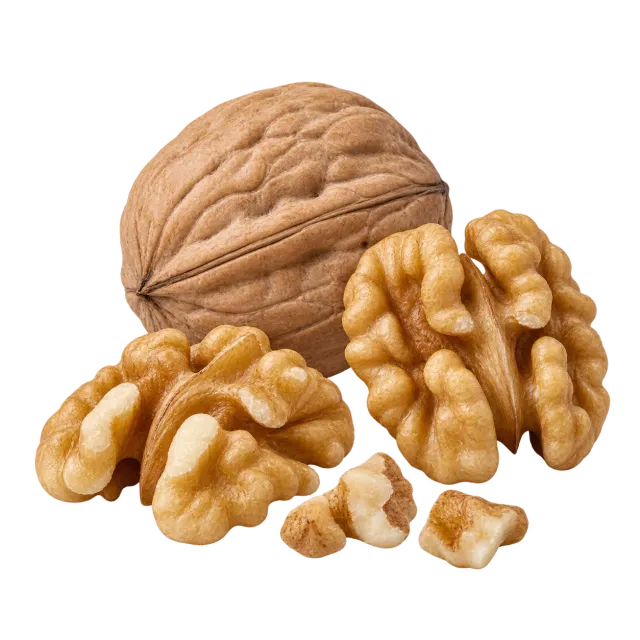
Fresh shelled kernelFor dogs and cats: With restrictions
An ordinary food-grade walnut with no shell, salt, oil, coating or seasoning.
For dogs
Conditions and restrictions
Do not use walnut as a routine treat. If you still offer it to a healthy dog, use only a fresh, shelled, unsalted kernel and give a tiny piece. Do not offer it without veterinary advice if the dog has pancreatitis, excess weight, a sensitive stomach or a prescribed diet.
Benefits
There is no special benefit: a complete diet already meets a dog’s needs, while walnut is very calorie-dense.
Risks
- A large fat load can cause vomiting or diarrhoea and may trigger pancreatitis in a susceptible dog.
- A large piece can lodge in the throat; an individual food reaction is also possible.
Already eaten — what now?
After a small piece of fresh, shelled, plain kernel, monitoring is usually enough. Confirm the amount and check for mould, shell, chocolate, onion, garlic or sweetener. Call a veterinarian for vomiting, diarrhoea, abdominal pain, lethargy or itching. Coughing, choking, facial swelling or breathing difficulty need urgent care. Do not induce vomiting yourself.
For cats
Conditions and restrictions
Do not offer walnuts to a cat. If the cat accidentally ate a crumb, first confirm that it was a fresh, shelled kernel with no additions. Discuss even small treats with a veterinarian if the cat has a chronic condition or prescribed diet.
Benefits
There is no benefit for a cat: walnut does not replace animal protein or a complete diet.
Risks
- The fatty, calorie-dense kernel may cause vomiting or diarrhoea and displaces complete food.
- A large piece can lodge in the throat; an individual food reaction is also possible.
Already eaten — what now?
Monitor after a crumb of fresh, shelled, plain kernel. Confirm the amount and check for mould, shell, chocolate, onion, garlic or sweetener. Call a veterinarian for vomiting, diarrhoea, pain, lethargy or refusal to eat. Coughing, choking, facial swelling or breathing difficulty need urgent care. Do not induce vomiting yourself.
Salted, oily or seasonedFor dogs and cats: With restrictions
Roasted, salted, caramelised or seasoned walnuts with a known recipe and no separately hazardous additions.
For dogs and cats
Conditions and restrictions
Do not offer salted, oil-roasted, caramelised or seasoned walnuts. This variant covers only a known recipe without chocolate, cocoa, onion, garlic or xylitol; hazardous or unknown additions are assessed separately.
Benefits
There is no benefit: salt, oil and seasonings only complicate the assessment.
Already eaten — what now?
Keep the packaging and check the full ingredient list. Monitor after one small piece with a known, non-hazardous recipe. Call a veterinarian if a large amount was eaten, the product is very salty or the ingredients are unknown. Repeated vomiting, marked thirst, unsteadiness, tremors or seizures need urgent care. Do not induce vomiting yourself.
For dogs
Risks
- Fat, salt and a large portion increase the risk of digestive upset; fatty food may trigger pancreatitis in a susceptible dog.
- A very salty product needs a separate assessment of the salt amount.
For cats
Risks
- Fat, salt and a large portion may cause vomiting, diarrhoea and an unnecessary calorie load.
- A very salty product needs a separate assessment of the salt amount.
Mouldy, rancid or fallenFor dogs and cats: Dangerous · Urgent help needed
A walnut with visible mould or a musty smell, from rubbish or compost, or left under a tree for a long time.
For dogs and cats
Conditions and restrictions
Do not offer a walnut with mould, a musty or rancid smell, or allow access to fallen nuts, rubbish or compost. A long-stored or fallen nut is not proven safe merely because mould is not visible.
Benefits
There is no benefit. Discard any mouldy, rancid or long-fallen walnut.
Risks
- Tremorgenic mycotoxins can cause vomiting, drooling, agitation, incoordination, tremors, fever and seizures.
- Severe poisoning may injure organs and requires hospital treatment.
Already eaten — what now?
Call a veterinarian immediately, even if there are no signs yet. Give your pet’s species and weight, the time, possible amount and where the walnut came from; bring a sample or photograph without exposing yourself to mould. Leave immediately for incoordination, tremors, seizures, fever, repeated vomiting or collapse. Do not induce vomiting or give an adsorbent unless a veterinarian directs you.
Shell or whole walnutFor dogs and cats: Dangerous · Urgent help needed
A whole walnut in shell, empty shell halves and large sharp fragments.
For dogs and cats
Conditions and restrictions
Remove the shell completely. Do not offer a whole walnut in shell or allow chewing on empty shell halves. Walnut-shell litter is not intended to be eaten either.
Benefits
There is no benefit: the shell is not edible.
Risks
- A whole walnut or large shell fragment can obstruct the airway or lodge in the oesophagus, stomach or intestine.
- Sharp edges may injure the mouth and digestive tract.
Already eaten — what now?
Remove the rest and call a veterinarian immediately if your pet swallowed a whole walnut or a substantial shell fragment. Give the size and amount. Coughing, drooling, repeated swallowing, vomiting, pain, refusal to eat or failure to pass stool need assessment; choking or breathing difficulty needs immediate care. Do not induce vomiting or try to push the object down with food.
Chocolate and other hazardous additionsFor dogs and cats: Dangerous · Urgent help needed
Chocolate-coated walnuts, cocoa desserts, mixtures with onion or garlic, and products containing xylitol or with unknown ingredients.
For dogs and cats
Benefits
There is no benefit: the additions may be more hazardous than the walnut itself.
For dogs
Conditions and restrictions
Do not offer chocolate-coated walnuts, cocoa desserts, mixtures with onion or garlic, or products with an unclear ingredient list. Check sugar-free products for xylitol, which is particularly dangerous to dogs.
Risks
- Chocolate can cause agitation, abnormal heart rhythm, tremors and seizures.
- Xylitol can rapidly lower a dog’s blood sugar and injure the liver; onion and garlic damage red blood cells.
Already eaten — what now?
Keep the packaging and call a veterinarian immediately. Give the full ingredient list, the dog’s weight, the amount and time. Do not wait for signs if the product contains chocolate, xylitol, onion or garlic, or if its ingredients are unknown. Weakness, incoordination, tremors, seizures, pale gums, fast breathing or collapse need immediate care. Do not induce vomiting yourself.
For cats
Conditions and restrictions
Do not offer chocolate-coated walnuts, cocoa desserts, mixtures with onion or garlic, or products with an unclear ingredient list. Check sweeteners on the package as well; the lack of established xylitol toxicity in cats does not make an unknown mixture safe.
Risks
- Chocolate can cause agitation, abnormal heart rhythm, tremors and seizures.
- Onion and garlic damage red blood cells; cats are particularly susceptible to alliums.
Already eaten — what now?
Keep the packaging and call a veterinarian immediately. Give the full ingredient list, the cat’s weight, the amount and time. Do not wait for signs if the product contains chocolate, onion or garlic, or if its ingredients are unknown. Weakness, incoordination, tremors, seizures, pale gums, fast breathing or collapse need immediate care. Do not induce vomiting yourself.
Conditions and risks
For dogs
Conditions and restrictions
Do not use walnut as a routine treat. If you still offer it to a healthy dog, use only a fresh, shelled, unsalted kernel and give a tiny piece. Do not offer it without veterinary advice if the dog has pancreatitis, excess weight, a sensitive stomach or a prescribed diet.
Benefits
There is no special benefit: a complete diet already meets a dog’s needs, while walnut is very calorie-dense.
Risks
- A large fat load can cause vomiting or diarrhoea and may trigger pancreatitis in a susceptible dog.
- A large piece can lodge in the throat; an individual food reaction is also possible.
For cats
Conditions and restrictions
Do not offer walnuts to a cat. If the cat accidentally ate a crumb, first confirm that it was a fresh, shelled kernel with no additions. Discuss even small treats with a veterinarian if the cat has a chronic condition or prescribed diet.
Benefits
There is no benefit for a cat: walnut does not replace animal protein or a complete diet.
Risks
- The fatty, calorie-dense kernel may cause vomiting or diarrhoea and displaces complete food.
- A large piece can lodge in the throat; an individual food reaction is also possible.
This card covers the common English or Persian walnut, Juglans regia. Black walnut, Juglans nigra, macadamia and other nuts do not inherit this rating. A fresh food-grade kernel, a fallen nut, a mouldy kernel, shell and a mixed product are different exposures.
Mould growing on nuts can produce tremorgenic mycotoxins. Dogs have developed vomiting, incoordination, tremors, fever and seizures after eating affected walnuts; a 2024 series described treatment of 54 dogs. There is no walnut-specific case series in cats, but poison-control guidance treats mouldy food containing these toxins as hazardous to cats as well. We therefore use a red rating for both species and state the evidence gap explicitly.
If the nut was an almond rather than a walnut, use the separate almond card; its forms and hazards differ.
Sources
- Merck Veterinary Manual: Tremorgenic Neuromycotoxicosis in Dogs
- Braun et al. (2024): Mycotoxin intoxication in 54 dogs after ingestion of walnuts
- Munday et al. (2008): Presumptive tremorgenic mycotoxicosis in a dog after eating mouldy walnuts
- Pet Poison Helpline: Moldy Food (Mycotoxins)
- ASPCA Animal Poison Control: People Foods to Avoid Feeding Your Pets
- ASPCA Animal Poison Control: Black Walnut
- Merck Veterinary Manual: Gastrointestinal Obstruction in Small Animals
- WSAVA Nutrition Committee: Feeding Treats to Your Dog
- WSAVA Nutrition Committee: Feeding Treats to Your Cat
- PetMD: Can Dogs Eat Walnuts?
- PetMD: What Human Food Can Cats Eat?
Comments
No comments yet.