
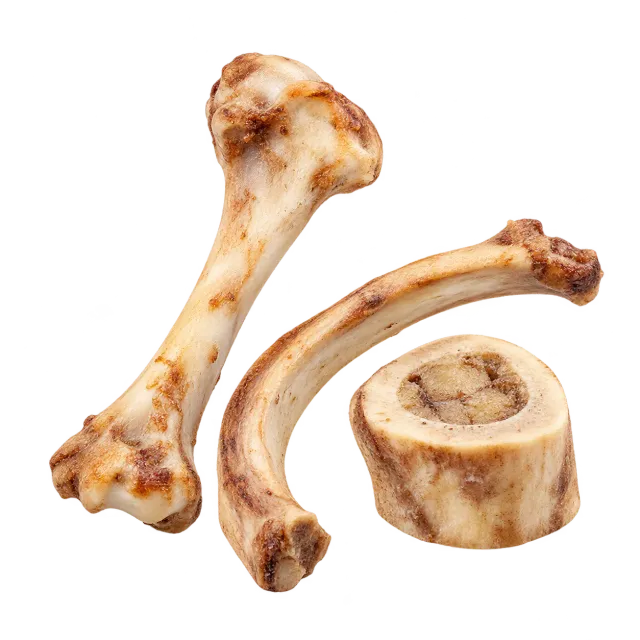
Already eaten — what now?
For dogs and cats
Urgent help neededRemove the remaining bones and call the clinic now. Give your pet’s species and weight, the bone type and approximate size, whether it was raw or cooked, the time and any signs. Do not induce vomiting, feed bread or other food to “push it through”, or pull on a lodged fragment. Leave immediately for breathing difficulty, continuous gagging, inability to swallow, sudden severe pain, profound weakness or collapse.
Variants and ingredients
Cooked, smoked and dried bonesFor dogs and cats: Dangerous · Urgent help needed
Bones and ribs after boiling, roasting, frying, smoking or drying.
For dogs and cats
Conditions and restrictions
Do not give boiled, roasted, fried, smoked or dried bones, including chicken, pork or beef bones and ribs. Cooking does not stop a bone being a hard foreign body, and it may break into sharp pieces.
Benefits
Whole bones are not needed in a complete diet for a dog or cat. A small, short study in eight Beagles found less dental calculus after chewing raw beef bones, but it does not establish safety for other animals, bone sizes or circumstances.
Risks
- A bone can fracture a tooth, lodge between teeth or in the throat or oesophagus, and cause choking.
- A swallowed fragment can injure the digestive tract and cause constipation, partial or complete obstruction, or perforation.
- Drooling, gagging, repeated swallowing, vomiting, refusal of food, pain, lethargy and difficulty passing stool may start immediately or later.
Already eaten — what now?
Remove the remaining bones and call the clinic now. Give your pet’s species and weight, the bone type and approximate size, whether it was raw or cooked, the time and any signs. Do not induce vomiting, feed bread or other food to “push it through”, or pull on a lodged fragment. Leave immediately for breathing difficulty, continuous gagging, inability to swallow, sudden severe pain, profound weakness or collapse.
Raw meaty and recreational bonesFor dogs and cats: Dangerous · Urgent help needed
Fresh raw bones, with or without meat, offered for chewing.
For dogs and cats
Conditions and restrictions
Do not give raw meaty bones or large recreational bones. Even when fresh and supervised, a bone can fracture a tooth or be swallowed. Raw animal material can also carry bacteria.
Benefits
Whole bones are not needed in a complete diet for a dog or cat. A small, short study in eight Beagles found less dental calculus after chewing raw beef bones, but it does not establish safety for other animals, bone sizes or circumstances.
Risks
- A bone can fracture a tooth, lodge between teeth or in the throat or oesophagus, and cause choking.
- A swallowed fragment can injure the digestive tract and cause constipation, partial or complete obstruction, or perforation.
- Drooling, gagging, repeated swallowing, vomiting, refusal of food, pain, lethargy and difficulty passing stool may start immediately or later.
- Raw meat and bones may carry Salmonella, Listeria, E. coli and other pathogens that cannot be identified by appearance.
Already eaten — what now?
Remove the remaining bones and call the clinic now. Give your pet’s species and weight, the bone type and approximate size, whether it was raw or cooked, the time and any signs. Do not induce vomiting, feed bread or other food to “push it through”, or pull on a lodged fragment. Leave immediately for breathing difficulty, continuous gagging, inability to swallow, sudden severe pain, profound weakness or collapse.
Fish bones, heads and backbonesFor dogs and cats: Dangerous · Urgent help needed
Raw or cooked fish parts that contain hard bones.
For dogs and cats
Conditions and restrictions
Do not give bony fish, heads, backbones or preparation scraps. For a treat, choose fully cooked fillet and check carefully for remaining bones.
Benefits
Whole bones are not needed in a complete diet for a dog or cat. A small, short study in eight Beagles found less dental calculus after chewing raw beef bones, but it does not establish safety for other animals, bone sizes or circumstances.
Risks
- A thin, sharp fish bone can lodge in the mouth, throat or oesophagus and injure tissue.
- A swallowed bone can obstruct or perforate the digestive tract.
Already eaten — what now?
Remove the remaining bones and call the clinic now. Give your pet’s species and weight, the bone type and approximate size, whether it was raw or cooked, the time and any signs. Do not induce vomiting, feed bread or other food to “push it through”, or pull on a lodged fragment. Leave immediately for breathing difficulty, continuous gagging, inability to swallow, sudden severe pain, profound weakness or collapse.
Large marrow and weight-bearing bonesFor dogs and cats: Dangerous · Urgent help needed
Dense leg bones and cross-cut sections containing marrow.
For dogs and cats
Conditions and restrictions
Do not give large beef or other dense weight-bearing or marrow bones. Being too large to swallow whole does not make a bone safe for teeth or prevent a pet from breaking off a piece.
Benefits
Whole bones are not needed in a complete diet for a dog or cat. A small, short study in eight Beagles found less dental calculus after chewing raw beef bones, but it does not establish safety for other animals, bone sizes or circumstances.
Risks
- A very hard bone can fracture a tooth crown and expose the painful pulp.
- A broken fragment or a ring-shaped cross-section can lodge in the mouth, oesophagus, stomach or intestine.
Already eaten — what now?
Remove the remaining bones and call the clinic now. Give your pet’s species and weight, the bone type and approximate size, whether it was raw or cooked, the time and any signs. Do not induce vomiting, feed bread or other food to “push it through”, or pull on a lodged fragment. Leave immediately for breathing difficulty, continuous gagging, inability to swallow, sudden severe pain, profound weakness or collapse.
Conditions and risks
For dogs and cats
Conditions and restrictions
Do not give whole or broken animal or fish bones, whether raw, cooked, smoked or dried. A pet’s size and supervision do not remove the risk. This card does not cover a finely ground mineral ingredient within a balanced commercial pet food.
Benefits
Whole bones are not needed in a complete diet for a dog or cat. A small, short study in eight Beagles found less dental calculus after chewing raw beef bones, but it does not establish safety for other animals, bone sizes or circumstances.
Risks
- A bone can fracture a tooth, lodge between teeth or in the throat or oesophagus, and cause choking.
- A swallowed fragment can injure the digestive tract and cause constipation, partial or complete obstruction, or perforation.
- Drooling, gagging, repeated swallowing, vomiting, refusal of food, pain, lethargy and difficulty passing stool may start immediately or later.
This card covers whole bones and bone fragments from meat and fish. Cooked boneless fish fillet is covered in our fish card. A finely ground mineral ingredient in complete commercial pet food is not assessed as a foreign body.
Sources
- Merck Veterinary Manual: Esophageal Foreign Bodies in Small Animals
- Merck Veterinary Manual: Gastrointestinal Obstruction in Small Animals
- FDA: Potentially Dangerous Items for Your Pet
- FDA: Keep Your Dogs and Cats Safe From Holiday Hazards
- AVMA: Raw or Undercooked Animal-Source Protein in Cat and Dog Diets
- Barash et al. (2022): Outcomes of esophageal and gastric bone foreign bodies in dogs
- Bongard et al. (2019): Esophageal foreign bodies in 114 dogs
- Rousseau et al. (2012): Esophageal foreign bodies in 34 dogs
- Abd Elkader et al. (2020): Oesophageal foreign bodies in cats
- Dollo et al. (2020): Endoscopic retrieval of gastric and oesophageal foreign bodies in 52 cats
- Marx et al. (2016): Raw beef bones as chewing items to reduce dental calculus in Beagle dogs
- UC Davis School of Veterinary Medicine: Dental Home Care Instructions
Comments
No comments yet.