
Already eaten — what now?
For dogs and cats
After a small amount of ripe tomato with no symptoms, observation is enough. If unripe fruit, leaves, stems or an unknown amount was eaten, contact a veterinarian and report the plant part, time, possible amount and the pet's weight. Repeated vomiting, weakness, loss of coordination, dilated pupils or a change in heart rate need urgent care. Do not induce vomiting or give home remedies unless a veterinarian instructs you to.
Variants and ingredients
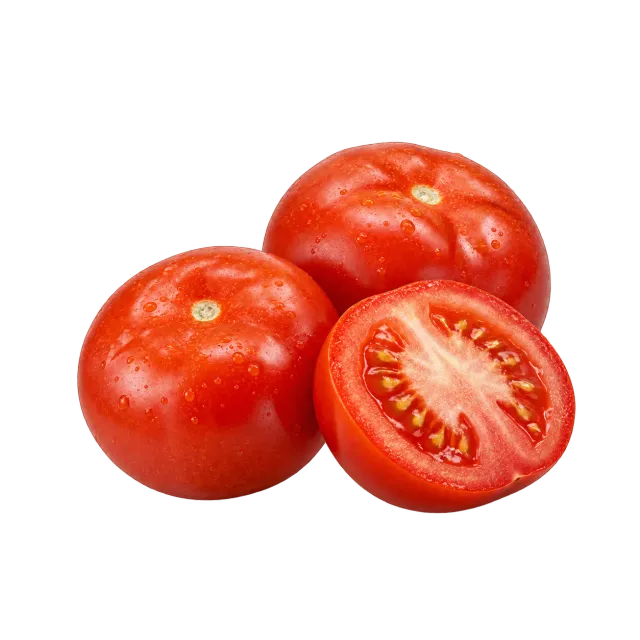
Plain ripe tomatoFor dogs and cats: Acceptable
Fully ripe fruit with the stalk, calyx and leaves removed.
For dogs and cats
Risks
- A large serving may cause vomiting or diarrhoea.
Already eaten — what now?
After a small amount with no symptoms, simply observe. Call a veterinarian for repeated vomiting, diarrhoea, pain or lethargy.
For dogs
Conditions and restrictions
Wash it, remove the stalk and every green part, then cut it into small pieces. Offer a small amount with nothing added.
Benefits
It can be an occasional low-calorie treat, but it does not replace regular food.
For cats
Conditions and restrictions
Wash it and remove the stalk and every green part. Offer only a tiny piece with nothing added.
Benefits
A tiny piece can be an occasional treat if your cat likes the taste. Cats have no dietary need for tomato.
Unripe green fruit, leaves or stemsFor dogs and cats: Dangerous · Urgent help needed
Green plant tissues and developing fruit contain more tomatine than ripe fruit.
For dogs and cats
Conditions and restrictions
Do not feed. Prevent access to leaves, stems and unripe green fruit. Fence off garden plants and pots.
Benefits
There is no benefit that justifies the risk.
Risks
- Tomatine and other plant alkaloids can cause drooling, loss of appetite, vomiting and diarrhoea.
- More serious exposure may cause weakness, lethargy, loss of coordination, disorientation, dilated pupils and changes in heart rate.
Already eaten — what now?
Remove access to the plant and call a veterinarian promptly. Report the part eaten, possible amount, time and the pet's weight. Weakness, loss of coordination, tremors, collapse or a change in heart rate need emergency care. Do not induce vomiting unless a veterinarian instructs you to.
Sauce, ketchup or dish with onion or garlicFor dogs: Dangerous · Urgent help neededFor cats: Dangerous · Especially dangerous
The risk comes from the prepared product's ingredients, not from ripe tomato itself.
For dogs and cats
Conditions and restrictions
Do not feed. Check sauces, ketchup, soups, seasonings and prepared dishes. Onion and garlic remain hazardous after cooking and in powdered form.
Benefits
There is no benefit that justifies exposure to onion or garlic.
Risks
- Onion and garlic damage red blood cells and can cause haemolytic anaemia; cats are more susceptible than dogs.
- Weakness, pale gums, rapid breathing, dark urine or jaundice may be delayed for several days.
Already eaten — what now?
Contact a veterinarian immediately and report the ingredients, possible amount, time and the animal's weight. Do not wait for symptoms in a cat. Do not induce vomiting or give home remedies unless instructed by a veterinarian.
Conditions and risks
For dogs and cats
Risks
- A large serving of ripe tomato may cause vomiting or diarrhoea.
- Unripe green fruit, leaves, stems and other green plant material contain more tomatine and can cause gastrointestinal and neurological signs.
For dogs
Conditions and restrictions
Offer only fully ripe, washed fruit with the stalk, calyx and leaves removed, and with no salt, oil or seasoning. Give a small amount in small pieces. All treats together should stay within 10% of daily calories.
Benefits
A small piece of ripe tomato can be a low-calorie treat, but dogs have no separate dietary need for it.
For cats
Conditions and restrictions
Offer only a tiny piece of fully ripe, washed fruit with the stalk, calyx and leaves removed, and with no salt, oil or seasoning. Do not coax your cat to eat tomato.
Benefits
Tomato has no special benefit for a cat. If your cat likes the taste, a tiny piece can be an occasional treat.
The answer depends on ripeness and the part of the plant. Fully ripe fruit contains little tomatine and veterinary toxicology sources consider it non-toxic. Unripe green fruit, leaves and stems contain more tomatine. Ripe colour varies by cultivar, so judge ripeness as well as colour.
Sources
- ASPCA Animal Poison Control: Tomato Plant
- Pet Poison Helpline: Tomato
- Australian OGTR: DIR 218 Risk Assessment and Risk Management Plan, section 3.4.1
- EFSA Journal: Risk assessment of glycoalkaloids in feed and food
- AAHA: Feeding Plans for Healthy, Appropriate Weight Cats and Dogs
- Merck Veterinary Manual: Garlic and Onion (Allium spp) Toxicosis
Comments
No comments yet.