
Already eaten — what now?
For dogs and cats
Urgent help neededRemove what remains and call the clinic now. Give your pet’s species and weight, the size of the cone or fragments, the approximate amount, the time and any signs. Say whether the cone was painted, scented or decorated. Do not induce vomiting or give food or oil to “push it through”. Leave immediately for breathing difficulty, inability to swallow, continuous gagging, repeated vomiting, severe pain, sudden weakness or collapse.
Variants and ingredients
Spruce coneFor dogs and cats: Dangerous · Urgent help needed
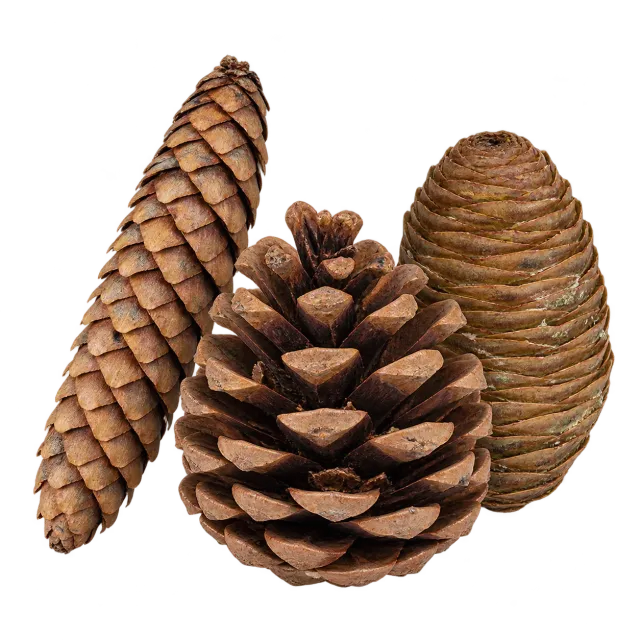
A whole Picea spruce cone or its woody scales.
For dogs and cats
Conditions and restrictions
Do not give fresh or dry spruce cones, whole or broken into scales.
Benefits
A cone is not needed in a dog’s or cat’s diet and is not a suitable chew toy.
Risks
- Hard scales can injure the mouth, throat or oesophagus, and a large cone can cause choking.
- A whole cone or fragments can lodge in the oesophagus, stomach or intestine and cause partial or complete obstruction.
- Drooling, gagging, repeated swallowing, vomiting, refusal of food, pain and lethargy may begin immediately or later.
Already eaten — what now?
Remove what remains and call the clinic now. Give your pet’s species and weight, the size of the cone or fragments, the approximate amount, the time and any signs. Say whether the cone was painted, scented or decorated. Do not induce vomiting or give food or oil to “push it through”. Leave immediately for breathing difficulty, inability to swallow, continuous gagging, repeated vomiting, severe pain, sudden weakness or collapse.
Pine coneFor dogs and cats: Dangerous · Urgent help needed
A fresh, closed, open or dry Pinus pine cone.
For dogs and cats
Conditions and restrictions
Do not give fresh or dry pine cones. An open cone remains a hard, inedible object with projecting scales.
Benefits
A cone is not needed in a dog’s or cat’s diet and is not a suitable chew toy.
Risks
- Hard scales can injure the mouth, throat or oesophagus, and a large cone can cause choking.
- A whole cone or fragments can lodge in the oesophagus, stomach or intestine and cause partial or complete obstruction.
- Drooling, gagging, repeated swallowing, vomiting, refusal of food, pain and lethargy may begin immediately or later.
Already eaten — what now?
Remove what remains and call the clinic now. Give your pet’s species and weight, the size of the cone or fragments, the approximate amount, the time and any signs. Say whether the cone was painted, scented or decorated. Do not induce vomiting or give food or oil to “push it through”. Leave immediately for breathing difficulty, inability to swallow, continuous gagging, repeated vomiting, severe pain, sudden weakness or collapse.
Cedar coneFor dogs and cats: Dangerous · Urgent help needed
A cone from true cedar, Cedrus, or a cedar pine, Pinus; not shelled edible nuts.
For dogs and cats
Conditions and restrictions
Do not give cones from true cedar, Cedrus, or a cedar pine, Pinus. The common name does not change the risk from the woody cone. Shelled edible nuts are outside this variant.
Benefits
A cone is not needed in a dog’s or cat’s diet and is not a suitable chew toy.
Risks
- Hard scales can injure the mouth, throat or oesophagus, and a large cone can cause choking.
- A whole cone or fragments can lodge in the oesophagus, stomach or intestine and cause partial or complete obstruction.
- Drooling, gagging, repeated swallowing, vomiting, refusal of food, pain and lethargy may begin immediately or later.
Already eaten — what now?
Remove what remains and call the clinic now. Give your pet’s species and weight, the size of the cone or fragments, the approximate amount, the time and any signs. Say whether the cone was painted, scented or decorated. Do not induce vomiting or give food or oil to “push it through”. Leave immediately for breathing difficulty, inability to swallow, continuous gagging, repeated vomiting, severe pain, sudden weakness or collapse.
Decorative or scented coneFor dogs and cats: Dangerous · Urgent help needed
A display cone with coating, fragrance, glue, glitter, wire or artificial snow.
For dogs and cats
Conditions and restrictions
Do not give decorative cones with fragrance, paint, varnish, glue, glitter, wire or artificial snow. Keep the packaging or photograph the item.
Benefits
A cone is not needed in a dog’s or cat’s diet and is not a suitable chew toy.
Risks
- Hard scales can injure the mouth, throat or oesophagus, and a large cone can cause choking.
- A whole cone or fragments can lodge in the oesophagus, stomach or intestine and cause partial or complete obstruction.
- Drooling, gagging, repeated swallowing, vomiting, refusal of food, pain and lethargy may begin immediately or later.
- Coatings and decorations add a separate risk that depends on the exact ingredients and parts of the item.
Already eaten — what now?
Remove what remains and call the clinic now. Give your pet’s species and weight, the size of the cone or fragments, the approximate amount, the time and any signs. Say whether the cone was painted, scented or decorated. Do not induce vomiting or give food or oil to “push it through”. Leave immediately for breathing difficulty, inability to swallow, continuous gagging, repeated vomiting, severe pain, sudden weakness or collapse.
Conditions and risks
For dogs and cats
Conditions and restrictions
Do not give spruce, pine or cedar cones or let a pet play with one in the mouth. This card covers whole cones and woody scales, not shelled edible pine nuts.
Benefits
A cone is not needed in a dog’s or cat’s diet and is not a suitable chew toy.
Risks
- Hard scales can injure the mouth, throat or oesophagus, and a large cone can cause choking.
- A whole cone or fragments can lodge in the oesophagus, stomach or intestine and cause partial or complete obstruction.
- Drooling, gagging, repeated swallowing, vomiting, refusal of food, pain and lethargy may begin immediately or later.
This card covers genuine untreated spruce, pine and cedar cones. Pine oil, yew, sago palm, needles and shelled edible pine nuts need separate assessment. If the plant is unknown, photograph the tree, needles and the object you found.
Sources
- Merck Veterinary Manual: Esophageal Foreign Bodies in Small Animals
- Merck Veterinary Manual: Gastrointestinal Obstruction in Small Animals
- Cornell University College of Veterinary Medicine: Gastrointestinal foreign body obstruction in dogs
- Ekinci et al. (2024): Esophageal Perforation and Pericarditis Case Caused by Chicken Scapula Bone in a Puppy
- Di Palma et al. (2022): Endoscopic and Surgical Removal of Gastrointestinal Foreign Bodies in Dogs
- Bowen et al. (2024): Critical upper gastrointestinal bleeding secondary to pine stall shaving ingestion and mechanical gastritis in a young dog
- Merck Veterinary Manual: Houseplants and Ornamentals Toxic to Animals
- Pet Poison Helpline: Pine Oil
- ASPCA: English Yew
- ASPCA: Yew Pine
Comments
No comments yet.