
Already eaten — what now?
For dogs and cats
After a small piece of ripe flesh with no symptoms, observe your pet. If they swallowed seeds, a whole fruit, a large piece, unripe or dried persimmon, or an unknown amount, call the clinic with the animal’s weight, the form eaten, the time and the estimated amount. Repeated vomiting, refusal of food or water, abdominal pain, tension or swelling, or marked lethargy need urgent assessment. Do not induce vomiting or give home remedies unless a veterinarian instructs you to.
Variants and ingredients
Ripe peeled fleshFor dogs and cats: With restrictions
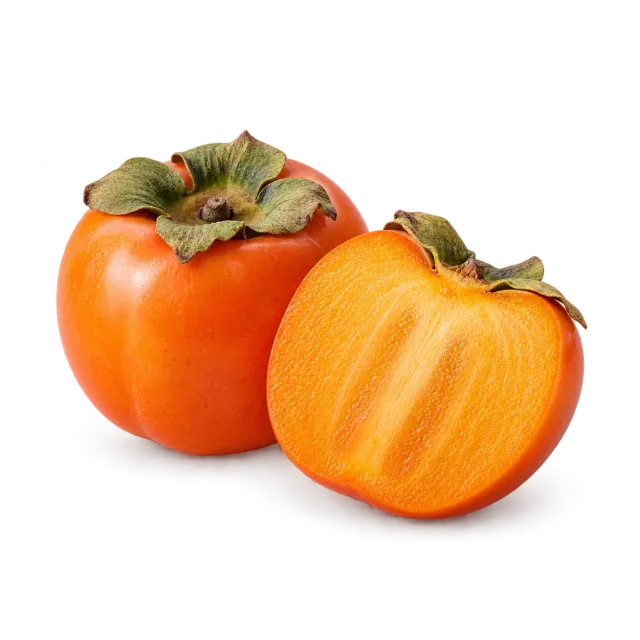
Fully soft fresh flesh with the skin, seeds and stem removed.
For dogs and cats
Risks
- Too much may upset digestion.
Already eaten — what now?
After a small amount with no symptoms, observation is enough. Call a veterinarian for repeated vomiting, diarrhoea, pain or lethargy.
For dogs
Conditions and restrictions
Remove the skin, every seed and the stem. Offer a small amount in small pieces.
Benefits
It can be an occasional fruit treat, but it does not replace regular food.
For cats
Conditions and restrictions
Remove the skin, every seed and the stem. Offer only a tiny piece.
Benefits
Cats have no dietary need for persimmon. A tiny piece is acceptable as an occasional treat if your cat likes it.
Whole fruit, seeds and large piecesFor dogs and cats: Dangerous · Urgent help needed
Forms that may lodge in the throat, stomach or intestine.
For dogs and cats
Conditions and restrictions
Do not offer a whole fruit, seeds or large pieces. An object that passes in one animal may lodge in another.
Benefits
There is no benefit for a pet.
Risks
- Choking, partial or complete obstruction, intestinal injury, and the need for endoscopy or surgery are possible.
Already eaten — what now?
Call the clinic straight away even if your pet still seems well. Give their weight, the size and number of swallowed pieces, the time and any signs. Leave urgently for vomiting, refusal of water, pain, swelling or sudden lethargy. Do not induce vomiting yourself.
Unripe or dried persimmonFor dogs and cats: With restrictions
Strongly astringent fresh fruit or dense dried flesh with no added ingredients.
For dogs and cats
Conditions and restrictions
Do not offer unripe, strongly astringent or dried persimmon. The form, amount and the animal’s digestive health matter after accidental ingestion.
Benefits
It offers no needed benefit beyond a complete diet.
Risks
- Dense fibre and tannins are associated with phytobezoar formation, but evidence specific to dogs and cats is limited. A large dried piece can also lodge in the digestive tract.
Already eaten — what now?
After a small amount with no symptoms, observe and call the clinic if the fruit was unripe or dried, swallowed as a large piece, or the amount is unknown. Repeated vomiting, refusal of food or water, pain, swelling or lethargy need urgent assessment.
Conditions and risks
For dogs and cats
Risks
- A large serving may cause vomiting or diarrhoea.
- Seeds, a whole fruit and large pieces can cause choking or obstruction. Dense plant material can sometimes form a phytobezoar.
For dogs
Conditions and restrictions
Offer only fully ripe fresh flesh with the skin, seeds and stem removed, in small pieces and a small amount. Keep all treats together within 10% of daily calories. Ask your veterinarian first if your dog has a prescribed diet, diabetes, excess weight or digestive disease.
Benefits
A small piece can be an occasional treat. A complete diet already supplies the nutrients a dog needs.
For cats
Conditions and restrictions
Offer only a tiny piece of fully ripe flesh with the skin, seeds and stem removed. Do not coax your cat to eat fruit. Ask your veterinarian first if your cat has a prescribed diet, diabetes, excess weight or digestive disease.
Benefits
Persimmon has no special benefit for a cat. If your cat likes the taste, a tiny piece can be an occasional treat.
Persimmon is not recognised as a routine poison for dogs or cats, but it still needs limits. Offer only a little ripe, peeled flesh. Seeds, a whole fruit and large pieces are foreign-body hazards. Unripe and dried persimmon contain more astringent compounds or dense plant material, so they are best left out.
Sources
- Gastrointestinal Phytobezoars in Small Animals: A Retrospective Study of 18 Cases
- MSD Veterinary Manual: Gastrointestinal Obstruction in Small Animals
- Review of the Diagnosis and Management of Gastrointestinal Bezoars
- Royal Veterinary Center: Persimmon
- WSAVA Global Nutrition Committee: Frequently Asked Questions and Myths
- WSAVA Nutrition Committee: Feeding Treats to Your Dog
Comments
No comments yet.