
Already eaten — what now?
For dogs and cats
Urgent help neededCall a veterinarian immediately even if your pet looks well. Give the species, weight, time, approximate amount, which part was eaten and whether it was fresh, cooked or dried. Keep the remaining dish, recipe or package. Do not induce vomiting or give home remedies unless a veterinarian specifically instructs you to. Travel immediately for weakness, pale or yellow gums, rapid breathing, dark urine, poor coordination or collapse.
Variants and ingredients
Fresh green onionFor dogs and cats: Dangerous · Urgent help needed
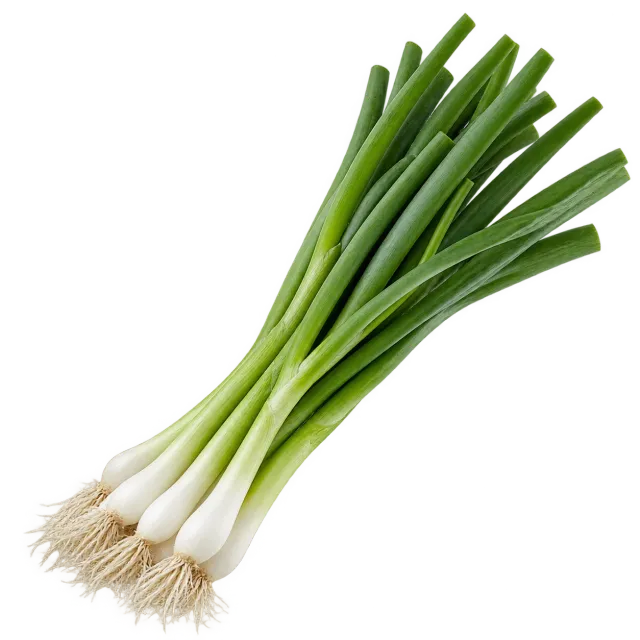
The white base, roots and green leaves, whole or chopped.
For dogs and cats
Conditions and restrictions
Do not offer green onion or add it to homemade food, broth or treats. Keep fresh onion and dishes containing it out of reach.
Benefits
There is no dietary benefit that justifies the risk.
Risks
- Sulfur-containing oxidants in Allium can damage red blood cells and cause Heinz body haemolytic anaemia.
- Vomiting and diarrhoea may occur. Weakness, pale or yellow gums, rapid breathing, dark urine and collapse can appear later.
- Repeated small exposures also matter because injury can accumulate, and cats are particularly susceptible.
Already eaten — what now?
Call a veterinarian immediately even if your pet looks well. Give the species, weight, time, approximate amount, which part was eaten and whether it was fresh, cooked or dried. Keep the remaining dish, recipe or package. Do not induce vomiting or give home remedies unless a veterinarian specifically instructs you to. Travel immediately for weakness, pale or yellow gums, rapid breathing, dark urine, poor coordination or collapse.
Cooked onion and dishes containing itFor dogs and cats: Dangerous · Urgent help needed
Boiled, fried, baked or frozen onion, including soups, sauces, salads, fillings and table scraps.
For dogs and cats
Conditions and restrictions
Do not offer a dish that contains green onion or another onion. Cooking and freezing do not remove the Allium hazard.
Benefits
There is no dietary benefit that justifies the risk.
Risks
- Sulfur-containing oxidants in Allium can damage red blood cells and cause Heinz body haemolytic anaemia.
- Vomiting and diarrhoea may occur. Weakness, pale or yellow gums, rapid breathing, dark urine and collapse can appear later.
- Repeated small exposures also matter because injury can accumulate, and cats are particularly susceptible.
Already eaten — what now?
Call a veterinarian immediately even if your pet looks well. Give the species, weight, time, approximate amount, which part was eaten and whether it was fresh, cooked or dried. Keep the remaining dish, recipe or package. Do not induce vomiting or give home remedies unless a veterinarian specifically instructs you to. Travel immediately for weakness, pale or yellow gums, rapid breathing, dark urine, poor coordination or collapse.
Dried, granulated or powdered onionFor dogs and cats: Dangerous · Urgent help needed
Dried flakes, powder, seasoning mixes, dry soups and other concentrated forms.
For dogs and cats
Conditions and restrictions
Check the ingredients of seasonings, stock mixes, baby food and prepared dishes. Keep concentrated forms sealed and out of reach.
Benefits
There is no dietary benefit that justifies the risk.
Risks
- Sulfur-containing oxidants in Allium can damage red blood cells and cause Heinz body haemolytic anaemia.
- Vomiting and diarrhoea may occur. Weakness, pale or yellow gums, rapid breathing, dark urine and collapse can appear later.
- Dried and powdered forms are concentrated, so a small volume may contain more onion than it appears.
Already eaten — what now?
Call a veterinarian immediately even if your pet looks well. Give the species, weight, time, approximate amount, which part was eaten and whether it was fresh, cooked or dried. Keep the remaining dish, recipe or package. Do not induce vomiting or give home remedies unless a veterinarian specifically instructs you to. Travel immediately for weakness, pale or yellow gums, rapid breathing, dark urine, poor coordination or collapse.
Conditions and risks
For dogs and cats
Conditions and restrictions
Do not offer green onion or add it to homemade food, broth or treats. Keep fresh onion and dishes containing it out of reach.
Benefits
There is no dietary benefit that justifies the risk.
For dogs
Risks
- Sulfur-containing oxidants in Allium can damage red blood cells and cause Heinz body haemolytic anaemia.
- Vomiting and diarrhoea may occur. Weakness, pale or yellow gums, rapid breathing, dark urine and collapse can appear later.
- Akitas, Shiba Inus and some other Japanese dog breeds may be more susceptible to Allium-related red blood cell injury.
For cats
Risks
- Sulfur-containing oxidants in Allium can damage red blood cells and cause Heinz body haemolytic anaemia.
- Vomiting and diarrhoea may occur. Weakness, pale or yellow gums, rapid breathing, dark urine and collapse can appear later.
- Repeated small exposures also matter because injury can accumulate, and cats are particularly susceptible.
This card covers green onion, also called scallion, spring onion or bunching onion. Both the white base and green leaves are hazardous. Raw, cooked, frozen, dried and powdered onion remain unsafe for pets.
Sources
- Merck Veterinary Manual: Garlic and Onion (Allium spp) Toxicosis in Animals
- Tang, Xia and Yu (2008): An experimental study of hemolysis induced by onion poisoning in dogs
- Robertson, Christopher and Rogers (1998): Heinz body formation in cats fed baby food containing onion powder
- Johnson et al. (2020): Heinz body hemolytic anemia in two cats after caramelized onion ingestion
- ASPCA Animal Poison Control: Onion (Allium cepa)
- Pet Poison Helpline: Onions and green onions
Comments
No comments yet.