
Already eaten — what now?
For dogs and cats
Check the recipe and estimate how much was eaten. After a small piece of fully cooked dolma with no hazardous ingredients and no symptoms, observe your pet and leave fresh water available. Call a veterinarian straight away if the recipe is unknown, the portion was large, or it contained onion, garlic, grapes, or raisins. Do not induce vomiting yourself. Repeated vomiting, marked weakness, pale gums, difficult breathing, dark urine, tremors, seizures, or a sudden change in urination needs urgent care.
Variants and ingredients
With onion or garlicFor dogs and cats: Dangerous · Urgent help needed
Onion, garlic, leek, spring onion, and their powders may be present in the filling, stock, sauce, or seasoning.
For dogs and cats
Conditions and restrictions
Do not offer dolma if the filling, sauce, stock, or seasoning contains onion, garlic, leek, spring onion, or their powders. Cooking does not remove the red-cell risk.
Benefits
There is no benefit that justifies feeding dolma made with onion or garlic.
Already eaten — what now?
Remove what remains and call a veterinarian straight away, even if your pet looks well. Give the species, weight, time, possible amount, and full recipe; keep the package or a photo of the ingredients. Do not induce vomiting or give home remedies unless a veterinarian instructs you. Leave immediately if you notice weakness, pale gums, difficult breathing, dark urine, jaundice, or collapse.
For dogs
Risks
- Onion and garlic can cause oxidative red-cell injury, Heinz body formation, and haemolytic anaemia.
- Vomiting and other gastrointestinal signs may appear first, while weakness, pallor, fast breathing, dark urine, and jaundice can develop several days later.
For cats
Risks
- Onion and garlic can cause oxidative red-cell injury, Heinz body formation, and haemolytic anaemia.
- Cats are particularly susceptible to oxidative red-cell injury. Weakness, pallor, fast breathing, dark urine, and jaundice can take several days to appear.
With grapes or raisinsFor dogs and cats: Dangerous · Urgent help needed
Some meat and vegetarian recipes include grapes, raisins, sultanas, Zante currants, or other dried fruit.
For dogs and cats
Conditions and restrictions
Do not offer dolma with added grapes, raisins, sultanas, or Zante currants. A vine-leaf wrapper does not mean the fruit is present; this rating applies to grapes or raisins added to the dish.
Benefits
There is no benefit that justifies feeding dolma containing grapes or raisins.
Already eaten — what now?
Remove what remains and call a veterinarian straight away without waiting for signs. Give the species, weight, time, possible amount of dolma, and how much grape or raisin it may have contained. Keep the recipe or package. Do not induce vomiting yourself. Leave for an open clinic if vomiting, lethargy, loss of appetite, abdominal pain, or changes in thirst or urination develop.
For dogs
Risks
- Grapes and raisins can cause acute kidney injury in dogs. The amount of the suspected toxic substance varies, so a safe amount cannot be calculated from a home recipe.
- Vomiting or diarrhoea may begin within hours, while lethargy, loss of appetite, and changes in thirst or urination can develop later.
For cats
Risks
- Gastrointestinal signs have been reported in cats after grape or raisin ingestion. Evidence of kidney injury is more limited than in dogs, and that limitation does not establish safety.
- The amount of fruit in the filling may be unknown, and cooking the dish does not establish that raisins are safe.
Conditions and risks
For dogs and cats
Conditions and restrictions
Check the full recipe first. Only a small piece of fully cooked dolma without onion, garlic, leek, spring onion, grapes, raisins, bones, hot sauce, or excess salt or fat is suitable. All treats together should usually stay within 10% of daily calories. Do not offer it without veterinary advice if your pet has pancreatitis, a food reaction, a prescribed diet, or another illness.
Benefits
Dolma has no special benefit over a suitable complete diet. A small piece made with safe ingredients can only be an occasional treat.
Risks
- Dolma recipes vary widely. The name alone does not reveal whether the filling contains onion, garlic, raisins, fatty meat, or a large amount of salt.
- A large or fatty portion can cause vomiting and diarrhoea; dietary indiscretion is associated with pancreatitis in susceptible dogs.
- The meat, rice, pulses, and vegetables in the dish do not make a complete diet for regular feeding.
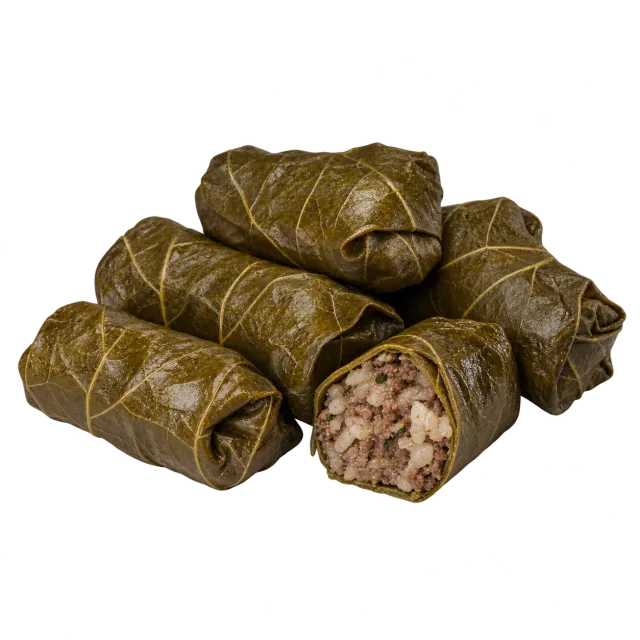
Dolma may be meat-filled or vegetarian, wrapped in vine or cabbage leaves, or made with stuffed vegetables. The full filling, sauce, and seasonings determine the rating. A vine leaf is not a grape or raisin, although the recipe may contain other hazardous ingredients.
Sources
- Armenia Travel: Armenian cuisine and tolma varieties
- FAO: Armenian Food Composition Table 2010
- Merck Veterinary Manual: Garlic and Onion (Allium spp) Toxicosis in Animals
- Harvey and Rackear (1985): Experimental onion-induced hemolytic anemia in dogs
- Merck Veterinary Manual: Grape, Raisin, and Tamarind Toxicosis in Dogs
- Dijkman et al. (2022): Vitis fruit-induced clinical signs and acute kidney injury in dogs and cats
- Pet Poison Helpline: Health and safety risks to pets from raisins
- WSAVA Nutrition Committee: Feeding Treats to Your Dog
- WSAVA Nutrition Committee: Feeding Treats to Your Cat
- Merck Veterinary Manual: Nutritional Requirements of Small Animals
- Merck Veterinary Manual: Pancreatitis in Dogs and Cats
Comments
No comments yet.