
Already eaten — what now?
For dogs and cats
If your pet ate a little plain chicory and seems normal, remove the rest and observe. Call a veterinarian for repeated vomiting, marked diarrhoea, pain, bloating or lethargy. Describe the product form, ingredients, approximate amount and time.
Variants and ingredients
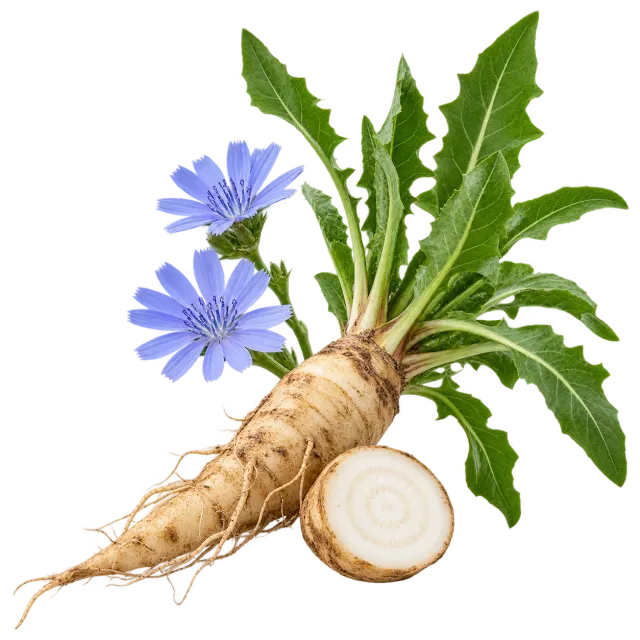
Plain fresh root and leavesFor dogs and cats: With restrictions
A small accidentally eaten piece of food-grade chicory, with no seasoning, sauce or other plants.
For dogs and cats
Conditions and restrictions
Do not use chicory as a daily supplement without veterinary guidance. If it is already part of a familiar complete food, assess the whole diet. Ask your veterinarian before adding it when your pet has intestinal disease or a prescribed diet.
Benefits
In a formulated diet, chicory can supply fermentable fibre. There is no need to add it separately to a complete diet unless a veterinarian has recommended it.
Risks
- Inulin and other fermentable fibres may cause gas, abdominal rumbling, soft stool or diarrhoea, especially after a large or unfamiliar amount.
- The studies used defined amounts of chicory or inulin in formulated diets; they do not establish a safe home dose of root, powder or supplement.
Already eaten — what now?
If your pet ate a little plain chicory and seems normal, remove the rest and observe. Call a veterinarian for repeated vomiting, marked diarrhoea, pain, bloating or lethargy. Describe the product form, ingredients, approximate amount and time.
Plain caffeine-free chicory drinkFor dogs and cats: With restrictions
Instant or brewed roasted root containing only chicory and water, with no coffee, cocoa, milk, sugar, sweeteners or flavourings.
For dogs and cats
Conditions and restrictions
Do not offer it deliberately. This rating applies only to a caffeine-free drink with no additions; check the full ingredient list.
Benefits
It has no benefit as a drink for a pet; water remains the appropriate drink.
Risks
- Inulin and other fermentable fibres may cause gas, abdominal rumbling, soft stool or diarrhoea, especially after a large or unfamiliar amount.
- The studies used defined amounts of chicory or inulin in formulated diets; they do not establish a safe home dose of root, powder or supplement.
Already eaten — what now?
If your pet ate a little plain chicory and seems normal, remove the rest and observe. Call a veterinarian for repeated vomiting, marked diarrhoea, pain, bloating or lethargy. Describe the product form, ingredients, approximate amount and time.
Inulin powder or concentrated supplementFor dogs and cats: With restrictions
Isolated chicory inulin, a prebiotic supplement or a large amount of chicory powder.
For dogs and cats
Conditions and restrictions
Use it only on veterinary advice and as a clearly labelled product. Do not calculate a pet dose from human directions.
Benefits
The fibre may be part of a prescribed diet, but adding it independently does not guarantee a benefit.
Risks
- Inulin and other fermentable fibres may cause gas, abdominal rumbling, soft stool or diarrhoea, especially after a large or unfamiliar amount.
- The studies used defined amounts of chicory or inulin in formulated diets; they do not establish a safe home dose of root, powder or supplement.
Already eaten — what now?
Put the package away and check the ingredients. After a small accidental amount with no signs, observe. Call a veterinarian if a large or unknown amount was eaten, or if repeated vomiting, marked diarrhoea, pain, bloating or lethargy develops.
Chicory blend containing caffeineFor dogs and cats: Dangerous · Urgent help needed
Powder or drink containing coffee, coffee extract, guarana or another listed source of caffeine.
For dogs and cats
Conditions and restrictions
Do not give chicory blended with coffee, coffee extract, guarana or another caffeine source. Keep the powder and prepared drink out of reach.
Benefits
There is no benefit that justifies giving this mixture.
Risks
- Caffeine may cause vomiting, diarrhoea, restlessness, a rapid or abnormal heart rhythm, tremors and seizures.
- Caffeine concentration varies between blends; the word chicory on the front does not prove that the product contains no coffee.
Already eaten — what now?
Keep the package and call a veterinarian straight away. Give your pet’s weight, the full ingredients, concentration or preparation method, approximate amount and time. Do not induce vomiting yourself. For tremors, seizures, collapse, marked agitation or breathing problems, go to an open veterinary clinic immediately.
Conditions and risks
For dogs and cats
Conditions and restrictions
Do not use chicory as a daily supplement without veterinary guidance. If it is already part of a familiar complete food, assess the whole diet. Ask your veterinarian before adding it when your pet has intestinal disease or a prescribed diet.
Benefits
In a formulated diet, chicory can supply fermentable fibre. There is no need to add it separately to a complete diet unless a veterinarian has recommended it.
Risks
- Inulin and other fermentable fibres may cause gas, abdominal rumbling, soft stool or diarrhoea, especially after a large or unfamiliar amount.
- The studies used defined amounts of chicory or inulin in formulated diets; they do not establish a safe home dose of root, powder or supplement.
This card covers food-grade chicory (Cichorium intybus): fresh root and leaves, roasted root, a plain instant drink and chicory inulin. Endive and radicchio, medicinal tinctures and multi-ingredient supplements need a separate ingredient assessment.
Chicory and inulin have been studied as parts of formulated diets, not as freely offered treats. The rating is therefore yellow: a small accidental amount of a plain product usually calls for observation, while supplements and therapeutic diets are best discussed with a veterinarian. Our guide explains how to assess a food as a whole.
Sources
- Swanson et al., 2002: Gastrointestinal and immunological responses of senior dogs to chicory and mannan-oligosaccharides
- Pouteau et al., 2005: Colonic fermentation of inulin increases whole-body acetate turnover in dogs
- Zentek et al., 2003: Dietary effects on bifidobacteria and Clostridium perfringens in the canine intestinal tract
- Verbrugghe et al., 2010: Intestinal fermentation of oligofructose and inulin in domestic cats
- Sparkes et al., 1998: Fructo-oligosaccharides and fecal flora of healthy cats
- Barry et al., 2011: Dietary fibres, gas and short-chain fatty acid production in cats
- Flickinger et al., 2003: Inulin and oligofructose in diets of domesticated animals
- ASPCA Animal Poison Control: People Foods to Avoid Feeding Your Pets
- ASPCA: Is It Ever Safe to Induce Vomiting?
Comments
No comments yet.